
Child development · Progress tracking
How to Track Children's Learning Progress and Personal Development (Ages 3–12)
A practical guide for teachers and parents: what to observe in children aged 3–12, simple ways to record progress, spotting patterns and when to get help.
By Ivailo Ivanov, Teacher
· 8 min read

Every child develops at their own pace, and rarely in a straight line. A four-year-old may talk in long sentences but still find it hard to share. An eight-year-old may read fluently but struggle with times tables. A single test or report card shows one moment. What really helps a child is seeing the pattern over weeks and months, early enough to support them.
This guide is for teachers in kindergartens and primary schools, and for parents who want to understand how their child's progress is followed. It covers what to look at between the ages of 3 and 12, simple ways to record what you see, how to spot patterns, and when to ask for professional advice.
What progress and development mean for children aged 3 to 12
"Progress" usually means learning: reading, writing, maths and other subjects. "Development" is wider. It covers how a child thinks, communicates, gets on with others, manages their feelings and moves. The two are closely linked. A child who cannot yet sit still and focus, or who is anxious about getting things wrong, will find learning harder, however clever they are.
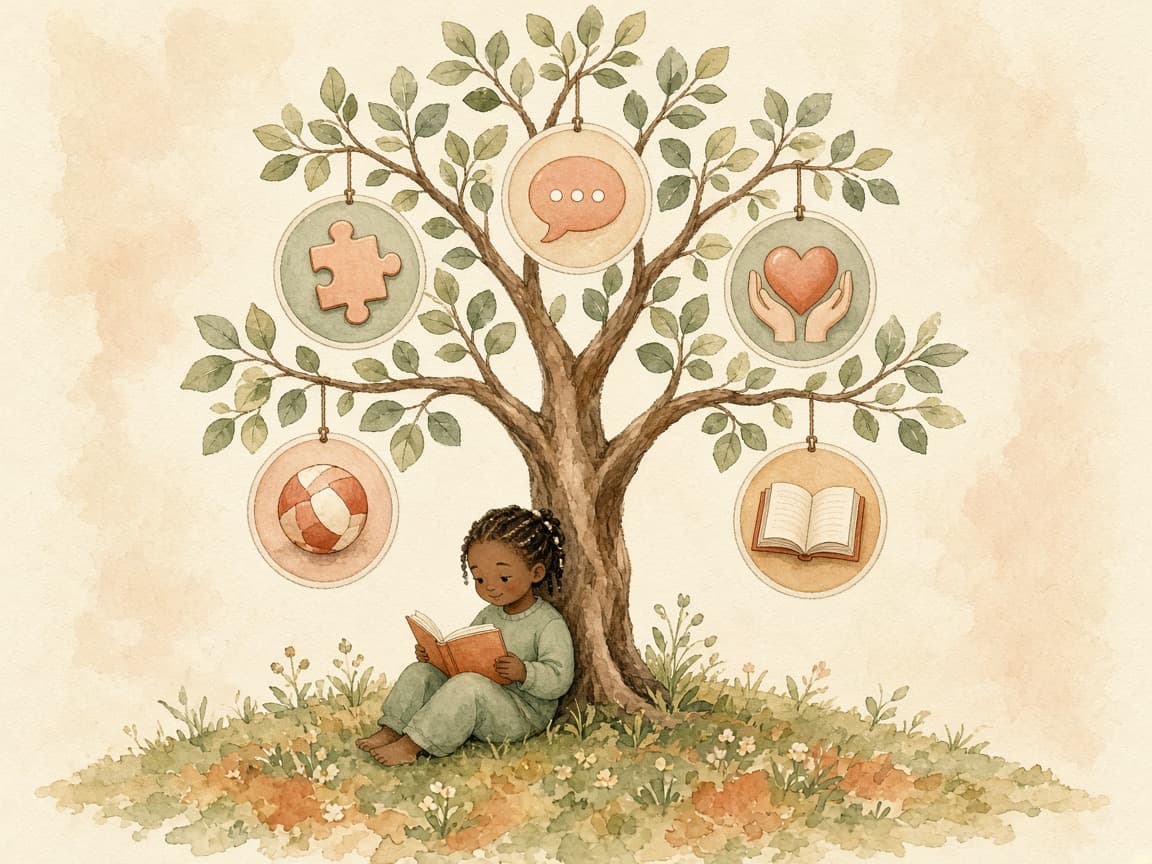
It helps to look at five areas.
| Area | Ages 3–6: what you might look for | Ages 6–12: what you might look for |
|---|---|---|
| Thinking and learning | Sorting, counting, simple puzzles, asking "why" | Reasoning, problem-solving, applying what they learned in new tasks |
| Language and communication | Following instructions, telling a short story, being understood by adults | Reading for meaning, explaining their thinking, writing for different purposes |
| Social and emotional | Taking turns, playing with others, naming feelings | Friendships, teamwork, coping with mistakes and frustration |
| Physical | Running, climbing, holding a pencil, using scissors | Coordination in sport, neat handwriting, stamina |
| Learning habits | Staying with an activity, tidying up, trying again | Concentration, organisation, independence, effort |
Not every child will show all of these at the same age, and that is normal. The aim is not to tick boxes but to know each child well enough to notice what they need next.
Milestones: useful, but use them carefully
For the youngest children, developmental milestones give a helpful reference point. The US Centers for Disease Control and Prevention (CDC) publishes free milestone checklists from 2 months to 5 years as part of its "Learn the Signs. Act Early." programme. They were revised in 2022 together with the American Academy of Pediatrics.
Two details of that revision are worth knowing:
- Milestones are placed at the age by which at least 75% of children show them, not at the average age. So if a child has not reached a milestone for their age, it is reasonable to talk to their doctor rather than wait and see.
- The checklists are communication tools, not screening tests. The CDC is explicit that they should not be used to diagnose a delay. They are meant to start a conversation between families, educators and doctors.
After about age 5, most of the useful reference points come from the school curriculum: what children are expected to know and do in each year group. Here, your own careful observations over time matter more than any single checklist.
Five practical ways to observe and record progress
You do not need complicated systems. These five methods work in kindergartens and primary classrooms, and most of them work at home too.
1. Short observation notes
A good observation note records what you saw, not what you think it means. Write the date, the situation and the child's actual words or actions.
- Less useful: "Maria is shy."
- More useful: "12 March, group game: Maria watched for about five minutes, then joined when invited by Leo. She spoke to Leo but not to the group."
The second note can be compared with a note a month later. The first cannot. Two or three short notes per child per week are plenty.
2. Checklists linked to clear goals
For skills you teach directly, a short checklist with three options, "yes", "not yet" and "not sure", is quick to fill in and easy to compare over time. It is the same format the CDC uses. Keep the list to the few skills that matter most this term.
3. Dated work samples
Keep a few pieces of work from the beginning, middle and end of each term: a drawing, a piece of writing, a maths page. Ideally use the same kind of task each time (for example "draw yourself" or "write about your weekend") so the change is easy to see. Parents find side-by-side samples far more convincing than a grade.
4. Regular quick checks during lessons
Two-minute checks during lessons, such as answer cards, mini whiteboards or exit tickets, show what each child understood that day. On their own they are snapshots. Saved over weeks, they become one of the most reliable signals you have. Our guide to 12 quick ways to check for understanding explains how to run them.
5. The child's own view
From about age 5 or 6, children can reflect on their own learning: "What did you find easy today?", "What do you want to get better at?". Simple "I can..." statements with a smiley scale work well for younger children. A child's view often explains a pattern that the other records only show.
What a useful progress record looks like
Whatever tool you use, paper or digital, a good progress record is:
- Dated, so you can see change over time.
- Specific: what the child did, not a label.
- Balanced: it records strengths as well as difficulties.
- Across areas, not only academic results.
- Comparable: similar tasks or checks repeated, so you compare the child with their own earlier self.
- Private: stored securely, shared only with the people who need it, and in line with your school's data protection rules.
A simple format is enough:
| Date | Area | What I saw | Next step |
|---|---|---|---|
| 4 Feb | Maths | Counted objects to 10 correctly, lost track above 12 | Counting games to 20 with grouping in tens |
| 18 Feb | Social | Asked to join a game for the first time | Pair with Leo again in group work |
| 3 Mar | Maths | Counted to 20 using groups of 10 | Introduce adding within 10 |
Spotting patterns over time
The real value of records appears when you look back over several weeks. Things worth noticing:
- Steady progress: a child moving forward, even slowly, is doing well. Compare the child with themselves, not with the fastest in the class.
- A plateau: no change over several weeks, despite teaching and practice, suggests the child needs a different approach or a missing earlier step.
- A sudden change: a child who becomes withdrawn, stops doing things they could do, or whose results drop sharply may be dealing with something outside the classroom. Talk to them and their family.
- A big gap between areas: for example, strong spoken language but very slow progress in reading. That is worth a closer look.
- Several sources agreeing: one low result can be a bad day. When observation notes, work samples and quick checks all point the same way, you can be much more confident.
Digital tools make the patterns easier to see because they keep every result in one place and draw the charts for you.
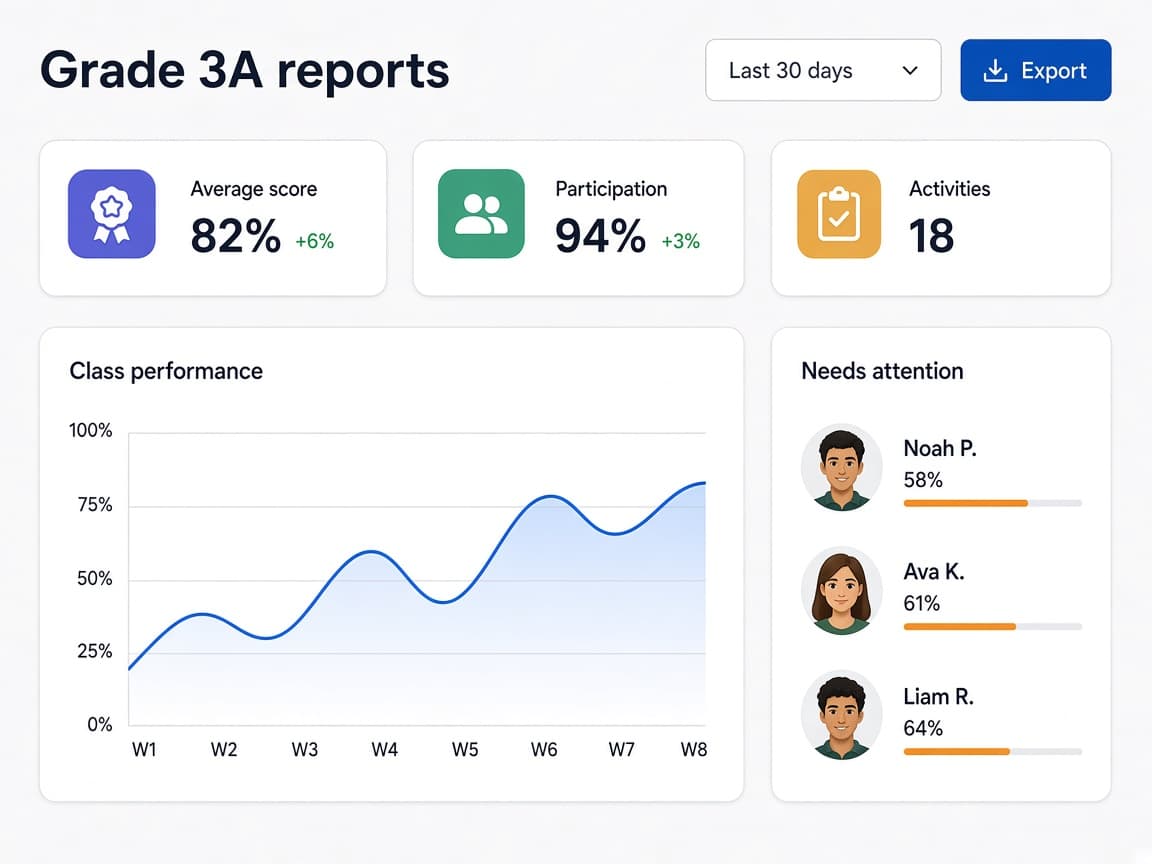
In SmartEduTrack, every quick check you run with a class is saved against each child. The reports show performance and participation over time for the class and for each student, and list the students who need attention, so you can follow up before a small gap grows.
Sharing progress with parents
Parents see a different side of their child. A good progress conversation is a two-way exchange, not a report being read out.
- Start with strengths, with a concrete example: "She explained to the group how she solved the puzzle."
- Show evidence: a work sample from September next to one from now, or a simple chart.
- Agree on one or two next steps, not ten.
- Suggest things to do at home that fit everyday life: reading together, talking about the day, board games with counting, and plenty of active play and sleep. For children aged 3 and 4, the World Health Organization recommends no more than one hour of sedentary screen time a day, and less is better.
- Ask what they notice at home. A child who is quiet in class may be very talkative at home, and that changes what you plan.
When to ask for professional advice
Teachers and parents are well placed to notice concerns, but not to diagnose. Talk to the child's doctor, and involve the school's special educational needs coordinator, psychologist or speech and language therapist where available, if:
- the child has lost skills they used to have;
- they have not reached several milestones for their age (for children up to 5);
- you have concerns about hearing, vision or speech;
- difficulties with attention, behaviour, friendships or learning continue despite support over several weeks;
- you, or the parents, simply feel that something is not right. The CDC's advice to families is clear: you know your child best, and you should not wait.
Acting early matters. Support is usually most effective when it starts early, and a conversation that turns out to be unnecessary costs very little.
Bringing it together
Tracking a child's progress and development does not require hours of paperwork. A few dated notes each week, regular quick checks during lessons, some work samples and an honest conversation with parents will tell you far more than an end-of-year grade. The key is to look for patterns, compare each child with their own earlier self, and act early when something does not look right.
If you want to collect those quick checks without extra marking, read why a student response system is worth using and how to get started.
Sources
- Centers for Disease Control and Prevention. CDC's Developmental Milestones, Learn the Signs. Act Early.
- Centers for Disease Control and Prevention. Key Points about CDC's Developmental Milestone Checklists.
- Centers for Disease Control and Prevention. Concerned About Your Child's Development?
- Centers for Disease Control and Prevention. Developmental Monitoring: Getting the Conversation Started, a fact sheet for early childhood educators.
- Zubler, J. M. et al. (2022). Evidence-Informed Milestones for Developmental Surveillance Tools. Pediatrics, 149(3).
- World Health Organization (2019). Guidelines on physical activity, sedentary behaviour and sleep for children under 5 years of age.
- Centers for Disease Control and Prevention. Positive Parenting Tips for children from infancy to adolescence.
Written by
Ivailo Ivanov, Teacher
Ivailo Ivanov is a teacher who writes about classroom practice, formative assessment and tracking children's learning progress.
Keep reading

Formative assessment
Formative Assessment: 12 Quick Ways to Check for Understanding in Any Lesson
12 practical formative assessment techniques to check every student's understanding in minutes, with age ranges, timings and device-free ideas.
Student response systems
Why Use a Student Response System? Benefits, Evidence and How to Start
What a student response system is, the research behind it, how cards compare with devices and hand-raising, and a 5-step plan for your first lesson.